
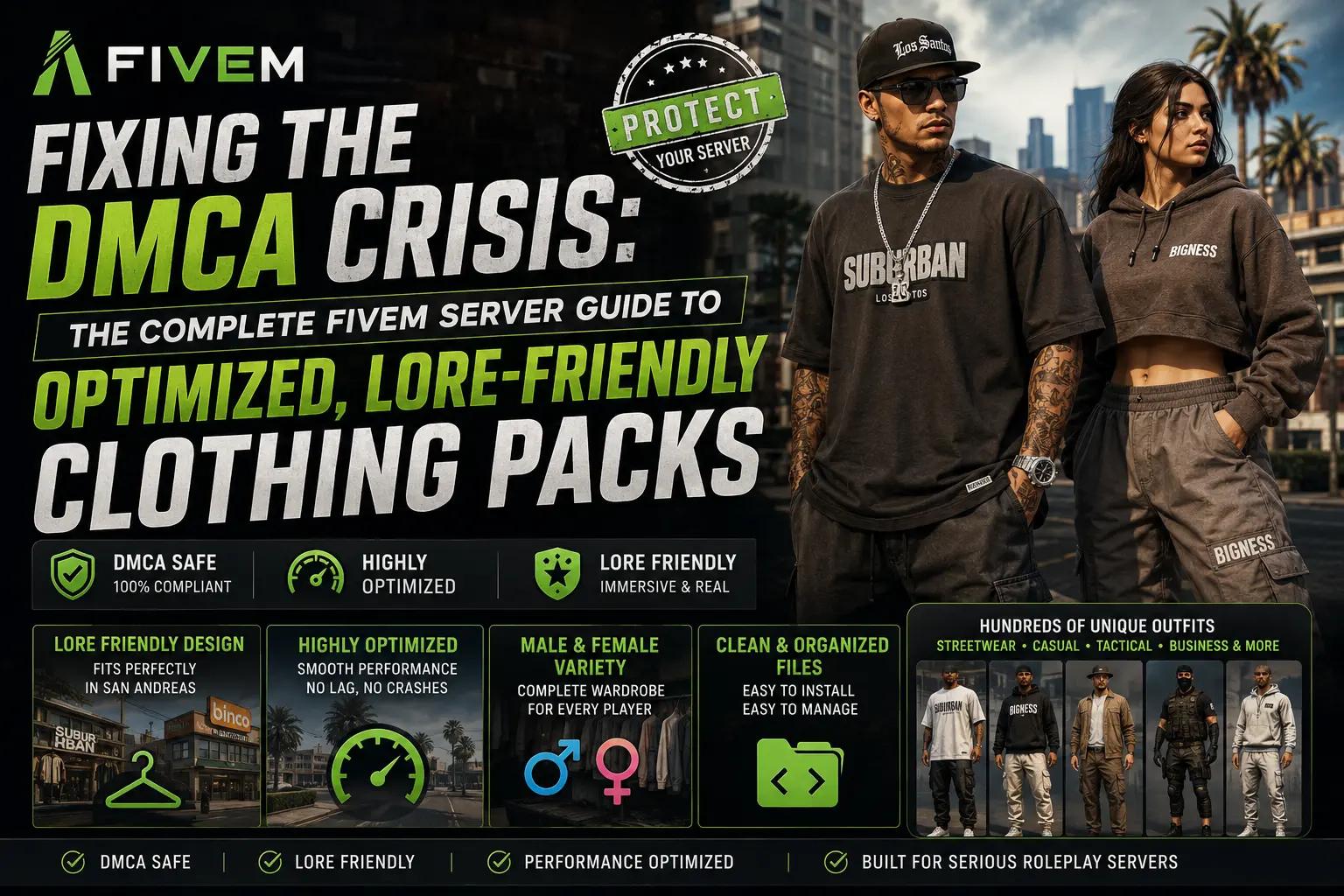
Running a successful multiplayer server requires constant attention to detail, resource management, and risk mitigation. For years, community managers and developers treated assets casually, downloading massive custom clothing packs with real-world luxury logos, designer footwear, and branded athletic gear. It seemed harmless. It gave players a way to express themselves and build unique identities during roleplay scenarios.
However, the operating environment changed permanently. Intellectual property enforcement hits servers harder than ever before. Platforms are actively issuing takedown notices, and communities that spent years building an audience are vanishing overnight due to trademark violations. Real-world brands do not want their logos associated with unpredictable roleplay actions, and automated detection systems make hiding these assets impossible.
This reality creates a massive structural headache for server owners. If you remove all your custom clothing, your players complain that the server feels vanilla, boring, and restrictive. If you keep the branded items, you risk a permanent community shutdown. The only viable path forward is a systematic migration toward a FiveM clothing pack built from the ground up to respect intellectual property while preserving visual variety. This is where an ultra-optimized, comprehensive infrastructure asset becomes an essential operational investment.
The Hidden Danger of Branded Clothing Assets
To fix a problem, you must first understand its scope. Many community owners assume that if they do not directly monetize their clothing scripts, they are safe from legal pushback. This is a dangerous misconception. Copyright and trademark laws apply regardless of whether an asset sits behind a paywall. When a real-world brand finds its trademarked imagery inside a custom asset file, it triggers a chain reaction that compromises the server's master list standing, its hosting provider agreements, and its core community infrastructure.
Beyond the legal vulnerability, branded assets carry severe technical penalties. Most of these files are direct rips from completely different video games, or high-poly models built by hobbyist artists who do not understand real-time game engine constraints. They contain uncompressed 4K textures, broken 3D models with excessive polygon counts, and messy file structures.
When twenty or thirty players gather in a central hub—like a popular car meet or a police department—your server begins streaming these massive, unoptimized files simultaneously. The results are instantly recognizable:
- Sudden texture loss where roads and buildings disappear.
- Severe micro-stuttering and sudden FPS drops for low-to-mid-spec player machines.
- Constant server hitching warnings in your console as the engine struggles to stream oversized physical files.
- Elevated memory usage that leads to frequent client-side game crashes.
Transitioning your community to an asset collection that balances legal safety with extreme engine optimization is the only way to safeguard your community’s longevity.
Deconstructing the Architecture of a Professional FiveM Wardrobe
A truly professional clothing asset pack must address three core pillars simultaneously: compliance, performance, and aesthetic diversity. Achieving a single one of these pillars is easy; balancing all three requires deep technical expertise.
1. Platform-Compliant Lore Design
What exactly does it mean to be "lore-friendly"? In the context of Grand Theft Auto V modification, lore-friendly assets match the fictional universe established by Rockstar Games. Instead of placing a real-world athletic logo on a shirt, a lore-friendly designer utilizes the fictional brands already present within the game’s universe—like Binco, Suburban, or Ponsonbys—or leaves the clothing entirely unbranded.
This preserves user immersion. A piece of clothing that feels like it naturally belongs in San Andreas keeps the roleplay grounded, whereas a modern real-world designer jacket can frequently shatter that carefully constructed atmosphere. Most importantly, utilizing non-branded FiveM clothes completely eliminates the threat of DMCA claims, protecting your community infrastructure from sudden platform strikes.
2. High-Performance Vertex and Texture Optimization
Game asset optimization relies heavily on balancing visual fidelity with strict technical limits. Every piece of clothing added to a game engine is a collection of vertices and polygons wrapped in a texture map. If a t-shirt contains more polygons than an entire vehicle model, it acts as a massive performance bottleneck.
Professional optimization involves rewriting asset files to utilize tight polygon structures and efficient texture pooling. Instead of a single hat utilizing an independent, uncompressed 10MB texture file, optimized bundles compress texture dimensions to appropriate physical scales (such as 512x512 or 1024x1024) while utilizing advanced compression formats. This allows the game engine to hold hundreds of clothing variations in memory simultaneously without causing texture loss or dropping client frame rates.
3. Balanced Gender Distribution and Variety
A major flaw in many public asset bundles is the extreme imbalance between male and female variations. Often, female character models are neglected, or their assets are plagued by severe clipping issues because they were poorly converted from male meshes. A stable server requires parity. Your player base is diverse, and providing a comprehensive male and female FiveM clothes asset collection ensures that every user can build a highly detailed persona without running into broken animations or invisible limbs.
Inside the Vault: A Look at the Clothing Package v2 Blueprint
To illustrate how these optimizations look in practice, let us examine the layout of our updated FiveM EUP package. This asset represents a complete baseline overhaul for server wardrobes, containing over 1,700 individual clothing items split almost equally between character models to ensure full communal variety.
| Male Wardrobe Category | Item Count | Female Wardrobe Category | Item Count |
|---|---|---|---|
| Jackets / Outerwear | 195 | Hairstyles | 255 |
| Shirts / Undercoats | 136 | Jackets / Outerwear | 253 |
| Hairstyles | 134 | Shirts / Undercoats | 171 |
| Pants / Legs | 90 | Scarves / Chains | 115 |
| Masks | 88 | Pants / Legs | 41 |
| Body Armor | 61 | Body Armor | 7 |
| Glasses | 61 | Masks | 6 |
| Hats / Helmets | 45 | - | - |
| Watches | 35 | - | - |
| Ear Accessories | 27 | - | - |
| Scarves / Chains | 8 | - | - |
| Bracelets | 6 | - | - |
By reviewing this breakdown, you can quickly see the strategic focus of the collection. Outerwear, shirts, and hairstyles dominate the list. These are the primary visual touchpoints that define a player's character model during interactions. By providing hundreds of clean, non-branded configurations in these specific categories, your server eliminates the need for players to seek out external, unsafe custom files.
The Performance Impact of Streaming Optimized Clothes
When a player connects to your community, their local client must download every custom asset your server hosts. If your custom clothing folder is an unmanaged 10-gigabyte monster filled with uncompressed civilian fashion packs, new players face long loading screens. Many users will simply cancel their connection if the initial download takes too long, destroying your server's player acquisition metrics.
An optimized FiveM clothing bundle addresses this issue by reducing the physical footprint of the files through proper data compression and LOD (Level of Detail) implementation. LODs ensure that if a character is standing fifty meters away from another player, the game engine renders a simplified, lower-polygon version of their clothing. The high-detail model is only rendered when the players are in close proximity.
Because this package organizes its 1,700+ assets with strict streaming efficiency in mind, the physical memory load on both your server hardware and your players' computers remains nominal. This makes it an ideal framework base for servers running high-capacity slot counts, where performance stability during large-scale community events is paramount.
How to Install a Drag-and-Drop Wardrobe Script
One of the most tedious aspects of development is manual asset mapping. In older asset installation methods, developers had to manually rename files, fix broken resource manifests, and carefully map texture slots to prevent overriding default game files. It was an incredibly slow process that often resulted in missing textures or broken character models.
Modern assets remove this friction entirely by providing a true drag and drop FiveM wardrobe. To install the Clothing Package v2 asset onto your server, the process is streamlined into three clean steps:
- Download and Extract: Secure the compressed asset file from the official platform and extract the directory using a standard archival tool.
- Move to Resources: Drag the unzipped folder directly into your server's main
resourcesdirectory. The folder is pre-configured with a optimizedfxmanifest.luafile, meaning all streaming paths are already mapped out for the game engine. - Ensure the Resource: Open your server’s root configuration file (
server.cfg) and add a clean line readingensure clothing_package_v2(or the exact name of the extracted folder). Restart your server, and the assets are instantly available across all in-game clothing stores, administrative menus, and character customization creators.
This rapid implementation style means you can transition your entire server from a high-risk, unoptimized wardrobe structure to a completely safe, high-performance configuration in less than five minutes of actual development time.
Strategic Benefits for Server Owners and Communities
Choosing the right base assets is a major business decision for server operators. Investing in a clean foundation provides concrete returns for your community's ecosystem:
Absolute Legal Protection
By choosing server compliant clothing, you remove the stress of unannounced platform bans. You can confidently build your brand, market your server on public listing boards, and grow your streaming community without worrying about a sudden trademark violation destroying your hard work.
Dramatic Reductions in Server Support Tickets
Ask any community helper or staff member what the most common player issue is, and the answer is usually client-side crashes or texture loss. By replacing unoptimized civilian clothing assets with clean, performance-tested files, you drastically minimize these engine resource overloads. This leads to fewer player complaints, a more stable gameplay environment, and a lighter workload for your support staff.
Enhanced Immersion and Organic Storytelling
When clothing choices align perfectly with the world's natural visual design, the quality of roleplay improves. Law enforcement officers look like they belong on the streets, criminals can access realistic tactical gear without looking like cartoon characters, and civilians can explore hundreds of unique streetwear combinations that feel grounded in reality. This consistency keeps players immersed in their characters, sparking longer play sessions and deeper story arcs.
Stop risking your server's future on unoptimized, trademarked clothing assets that degrade performance and invite platform strikes. Establish a clean, legal, and high-performance framework base for your community using our premium, professionally optimized wardrobe architecture. Check out the full breakdown and preview videos on our store today to give your players the ultimate legal fashion playground they deserve!